














immersive translate logoImmersive Translate
English
google
openAI
Gemini
DeepL
Microsoft
Tencent Smart
Volctrans
Youdao
DeepSeek
Baidu
Niu
Caiyun
Tencent
OpenL
BigModel
SiliconFlow
google
openAI
Gemini
DeepL
Microsoft
Tencent Smart
Volctrans
Youdao
DeepSeek
Baidu
Niu
Caiyun
Tencent
OpenL
BigModel
SiliconFlow
google
openAI
Gemini
DeepL
Microsoft
Tencent Smart
Volctrans
Youdao
DeepSeek
Baidu
Niu
Caiyun
Tencent
OpenL
BigModel
SiliconFlow

Video translation demo

Translate Podcast to Chinese Effortlessly
Immersive Translate Video Translator transforms how you translate podcast to Chinese by delivering real-time bilingual subtitles directly during playback. Unlike traditional tools requiring download-transcribe-translate workflows, it integrates seamlessly with 60+ platforms, letting you understand content instantly while preserving original context through side-by-side subtitle display for maximum comprehension.
Before
user-pain-points
User Pains
Waiting hours for transcription before accessing translations
Losing original context with translation-only subtitle outputs
Complicated workflows requiring multiple separate processing steps
After
happy-emoji
solutions
Immersive Translate Solution
happy-emojiReal-time bilingual subtitles appear instantly during podcast playback
happy-emojiSide-by-side display preserves original audio context while translating
happy-emojiOne-click translation across YouTube and major podcast platforms
happy-emojiAI-powered subtitle generation for podcasts without existing captions

Four steps to enjoy content in your native language

1

Copy & paste video link

2

Click Translate Video and wait a moment

3

Click Play Immediately to view

Translate Podcast to Chinese Instantly

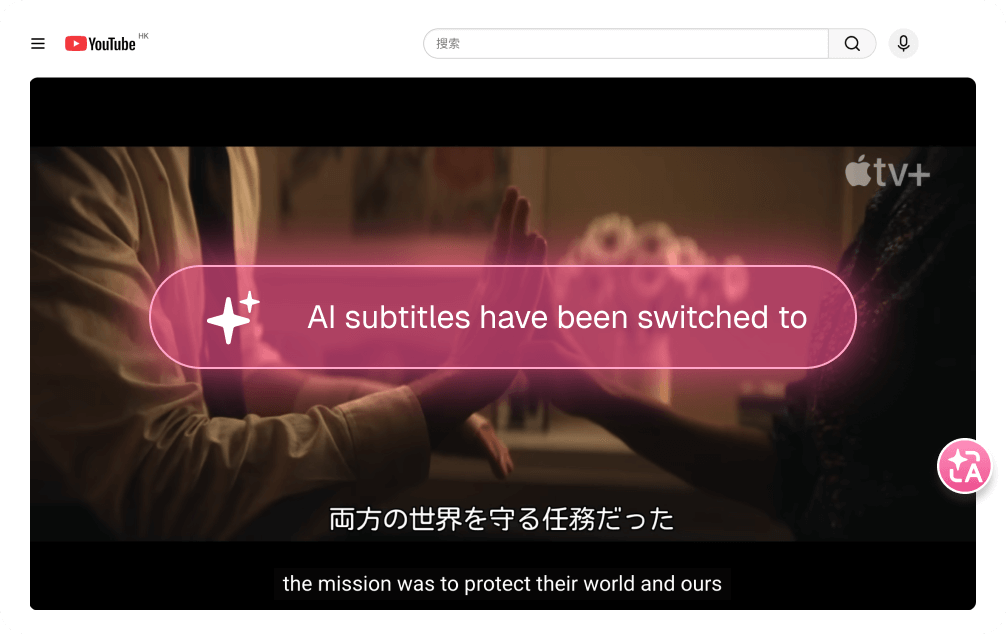
Real-Time Understanding

Watch and comprehend Chinese podcast translations simultaneously without waiting for audio processing or transcription completion, enabling instant access to foreign-language podcast content.

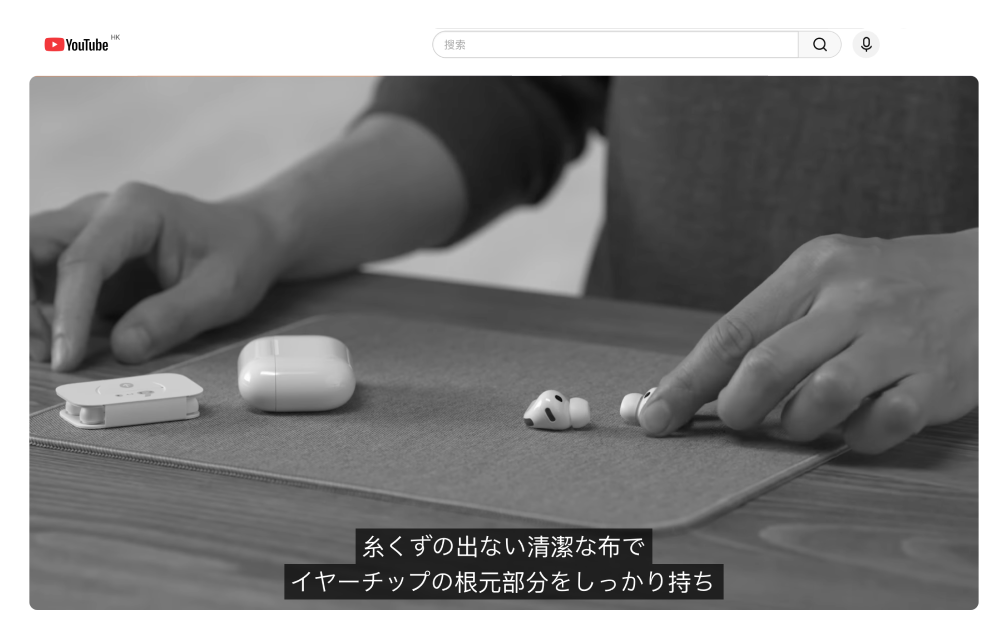
Bilingual Display

Side-by-side original and Chinese subtitles preserve linguistic context while delivering meaning, perfect for language learners studying podcast conversations and terminology.


Bilingual Display
Multi-Platform Coverage

Translate podcasts to Chinese across YouTube, embedded players, and major video platforms using browser extensions or direct link input for consistent experience.

AI Subtitle Generation

Automatically generate Chinese subtitles for podcasts without existing captions using advanced speech recognition, then translate into your preferred language instantly.

AI Subtitle Generation
Customizable Subtitle Styles

Adjust Chinese subtitle font size, color, background opacity, and screen position to ensure optimal readability during long podcast listening sessions across devices.

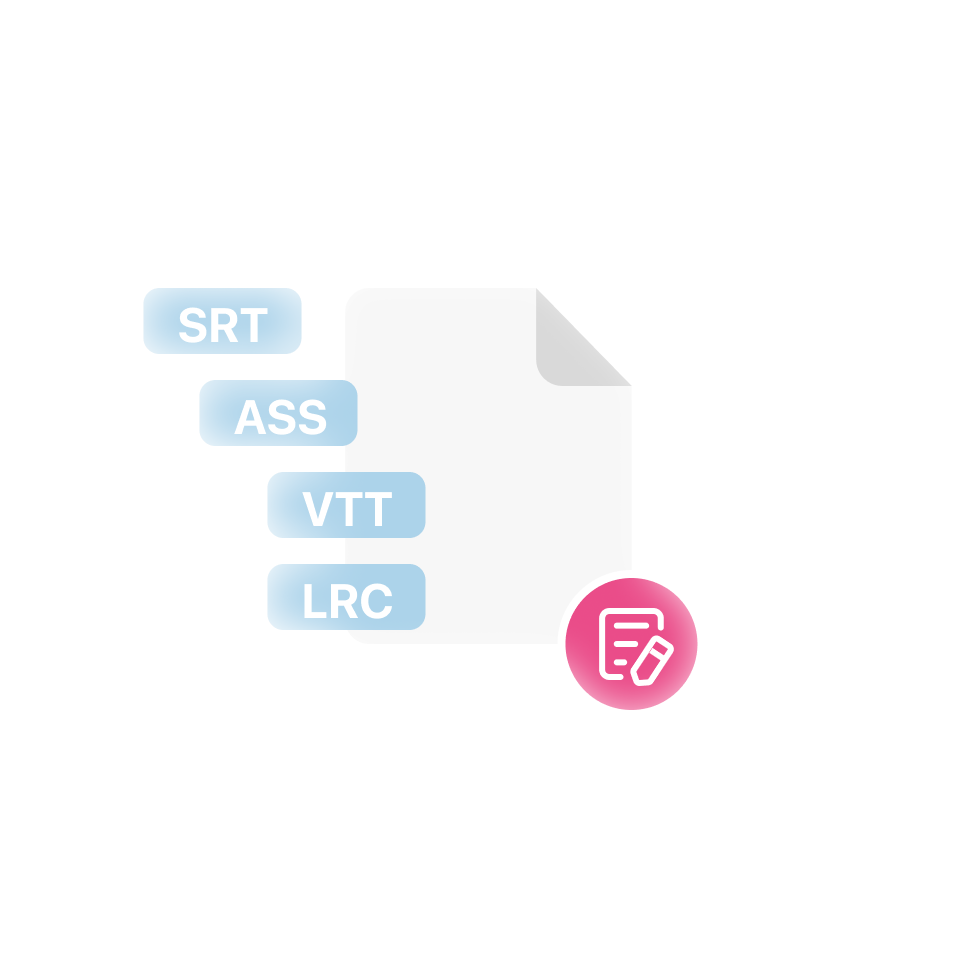
Export Bilingual Transcripts

Download translated podcast subtitles in SRT format with original and Chinese text for study notes, content repurposing, or creating localized podcast materials.

Export Bilingual Transcripts

Supported categories

Streaming Services
Video Sharing
Online Education
Social Networking
News & Information
Creator Platforms
Developer & Technology Platforms

Frequently Asked Questions About Translating Podcasts to Chinese

Can I translate podcast episodes to Chinese in real-time while listening?
Yes, with Immersive Translate's video translation feature, you can translate podcast content to Chinese in real-time. When podcasts are hosted on supported platforms like YouTube or embedded video players, our browser extension displays bilingual subtitles side-by-side as you listen. This means you see both the original English audio transcription and the Chinese translation simultaneously, allowing you to understand the content without pausing or waiting for processing. For podcast videos on platforms like YouTube, simply enable the extension and activate bilingual subtitles—the translation appears instantly as the podcast plays. This approach is fundamentally different from traditional podcast translation methods that require you to download, transcribe, translate, and then re-listen to the content. Instead, you comprehend the podcast in Chinese while maintaining access to the original language context, which is particularly valuable for language learners who want to improve their listening skills while understanding the full meaning.
What if my favorite podcast doesn't have subtitles or transcripts available?
Immersive Translate's AI subtitle generation capability solves this exact problem for podcast translation to Chinese. When you encounter a podcast video on YouTube without any captions or closed captions, our Pro membership feature automatically detects the speech and generates accurate subtitles in the original language. Once these AI-generated subtitles are created, they're immediately translated into Chinese and displayed bilingually alongside the original text. This is especially useful for independent podcasters or smaller shows that don't have the resources to create professional transcripts. The AI subtitle generation works by analyzing the audio stream, identifying speech patterns, and converting them into text with high accuracy—even handling different accents and speaking speeds. After generation, you can edit the subtitles if needed to correct any terminology or proper nouns specific to the podcast topic, then export the bilingual subtitle file in SRT or ASS format for future reference or sharing with other Chinese-speaking listeners who might benefit from the translation.
How accurate is the Chinese translation for specialized podcast content like business, technology, or academic topics?
Immersive Translate provides exceptional accuracy for translating specialized podcast content to Chinese by leveraging over 20 top-tier AI translation engines, including ChatGPT, DeepL, DeepSeek, and Gemini. You can select the translation service that performs best for your specific podcast genre—for instance, DeepL often excels at technical and business terminology, while ChatGPT handles context-dependent phrases and idiomatic expressions particularly well. The system uses context-aware translation, meaning it doesn't translate each sentence in isolation but considers the surrounding dialogue to produce natural, fluent Chinese output. For podcasts covering specialized fields like financial analysis, medical research, or software development, this contextual understanding is crucial for accurate terminology translation. Additionally, after the podcast is translated to Chinese, you can use the subtitle editing feature to refine any technical terms or industry jargon that might need adjustment. This combination of multiple AI engines, contextual awareness, and manual editing capability ensures that even highly specialized podcast content is translated to Chinese with professional-level accuracy, making it suitable for researchers, professionals, and students who need precise understanding of domain-specific discussions.
Can I translate podcast audio files I've downloaded to my computer?
While Immersive Translate is primarily designed for translating podcast videos on streaming platforms, you can still translate downloaded podcast content to Chinese through our subtitle file translation feature. If you have a podcast audio file with an accompanying subtitle or transcript file in formats like SRT or ASS, you can upload that subtitle file directly to Immersive Translate for translation to Chinese. The system will process the entire subtitle file and provide a bilingual output that you can export and use with your local media player. For podcast videos you've downloaded, if they contain embedded subtitles or if you can extract the audio and generate subtitles using third-party transcription tools, you can then translate those subtitles to Chinese using our platform. However, for the most seamless experience translating podcasts to Chinese, we recommend using the web version by pasting the podcast's YouTube link or using our browser extension while streaming the podcast on supported platforms. This approach provides real-time bilingual subtitle display without requiring file downloads or conversions, and it works across 60+ major video platforms where podcasts are commonly hosted, ensuring you can translate podcast content to Chinese regardless of where you discover it.
Is there a way to save the Chinese translation of a podcast for offline study or sharing?
Absolutely. Immersive Translate offers robust subtitle export functionality that's perfect for podcast learners and content creators who want to save Chinese translations for later use. After translating a podcast to Chinese using either the web version or browser extension, you can export the complete bilingual subtitle file in industry-standard formats like SRT or ASS. These exported files contain both the original podcast transcript and the Chinese translation, time-stamped and synchronized with the audio. This is incredibly valuable for several use cases: language learners can review the bilingual transcript offline to study vocabulary and sentence structures; students can create study notes from educational podcasts; content creators can repurpose translated podcast content for their Chinese-speaking audience; and professionals can compile bilingual meeting minutes from recorded podcast-style discussions. The exported subtitle files can be opened in any text editor for further editing, imported into video editing software if you're creating derivative content, or simply kept as reference material. For podcasts you translate regularly, building a library of bilingual subtitle files creates a valuable resource for language learning or professional development, allowing you to search through past podcast translations and review specific topics or terminology in Chinese whenever needed.
How does translating podcasts to Chinese with Immersive Translate compare to using separate transcription and translation tools?
Translating podcasts to Chinese with Immersive Translate offers a fundamentally superior workflow compared to using separate transcription and translation tools. Traditional methods require you to first use a transcription service like Notta or TurboScribe to convert the podcast audio to text, then copy that text into a translation tool like Google Translate, and finally try to synchronize the translation back with the audio timing—a process that can take hours for a single podcast episode. Immersive Translate eliminates this entire multi-step workflow by integrating translation directly into the podcast listening experience. When you play a podcast on YouTube or other supported platforms, the Chinese translation appears in real-time alongside the original subtitles, allowing you to understand the content immediately without any processing delay. This 'understand while listening, not after processing' approach means you're not waiting for transcription to finish or manually managing multiple tools. Additionally, because Immersive Translate displays bilingual subtitles side-by-side, you maintain access to the original language context while reading the Chinese translation—something that's lost when using separate tools that only show translated text. For language learners translating podcasts to Chinese, this bilingual presentation is invaluable for comparing expressions, learning new vocabulary in context, and developing listening comprehension skills simultaneously with content understanding.
Can I customize how the Chinese translation appears when translating podcasts?
Yes, Immersive Translate provides extensive customization options for how Chinese translations appear during podcast playback, ensuring optimal readability for your specific needs. You can adjust the subtitle font, size, color, background opacity, and screen position to create the perfect viewing experience when translating podcasts to Chinese. This is particularly important because podcast listening contexts vary widely—you might be watching on a large desktop monitor, a laptop screen, or a mobile device, and the ideal subtitle presentation differs for each scenario. For instance, if you're translating educational podcasts to Chinese for study purposes, you might prefer larger font sizes and higher contrast backgrounds to make note-taking easier. If you're casually listening to entertainment podcasts while multitasking, you might choose smaller, less obtrusive subtitles positioned at the bottom of the screen. The customization extends to how the bilingual subtitles are arranged: you can choose whether the Chinese translation appears above or below the original text, adjust spacing between lines, and even modify the timing offset if you notice any synchronization issues. These customization capabilities ensure that when you translate podcast content to Chinese, the presentation matches your personal preferences, viewing environment, and learning or entertainment goals, making the experience as comfortable and effective as possible across different podcast genres and listening situations.