














immersive translate logoImmersive Translate
English
google
openAI
Gemini
DeepL
Microsoft
Tencent Smart
Volctrans
Youdao
DeepSeek
Baidu
Niu
Caiyun
Tencent
OpenL
BigModel
SiliconFlow
google
openAI
Gemini
DeepL
Microsoft
Tencent Smart
Volctrans
Youdao
DeepSeek
Baidu
Niu
Caiyun
Tencent
OpenL
BigModel
SiliconFlow
google
openAI
Gemini
DeepL
Microsoft
Tencent Smart
Volctrans
Youdao
DeepSeek
Baidu
Niu
Caiyun
Tencent
OpenL
BigModel
SiliconFlow

Video translation demo

Best DeepLearning.ai Course Translator for AI Education

Immersive Translate transforms how you learn from DeepLearning.ai courses by providing real-time bilingual subtitles directly during video playback. Unlike traditional tools requiring download-translate-rewatch workflows, it integrates AI-powered translation into your viewing experience, supporting multiple advanced models like ChatGPT and Claude for context-aware subtitle understanding across technical terminology.
Before
user-pain-points
User Pains
Traditional tools require downloading videos before translating content
Post-processing workflows interrupt learning flow and momentum completely
Single-language output loses original technical terms and context
After
happy-emoji
solutions
Immersive Translate Solution
happy-emojiWatch and understand simultaneously without workflow interruption
happy-emojiBilingual subtitles preserve technical terms alongside translated explanations
happy-emojiAI models deliver context-aware translation for complex AI concepts
happy-emojiBrowser extension works directly on course platforms instantly

Four steps to enjoy content in your native language

1

Copy & paste video link

2

Click Translate Video and wait a moment

3

Click Play Immediately to view

DeepLearning.ai Course Translator That Actually Works
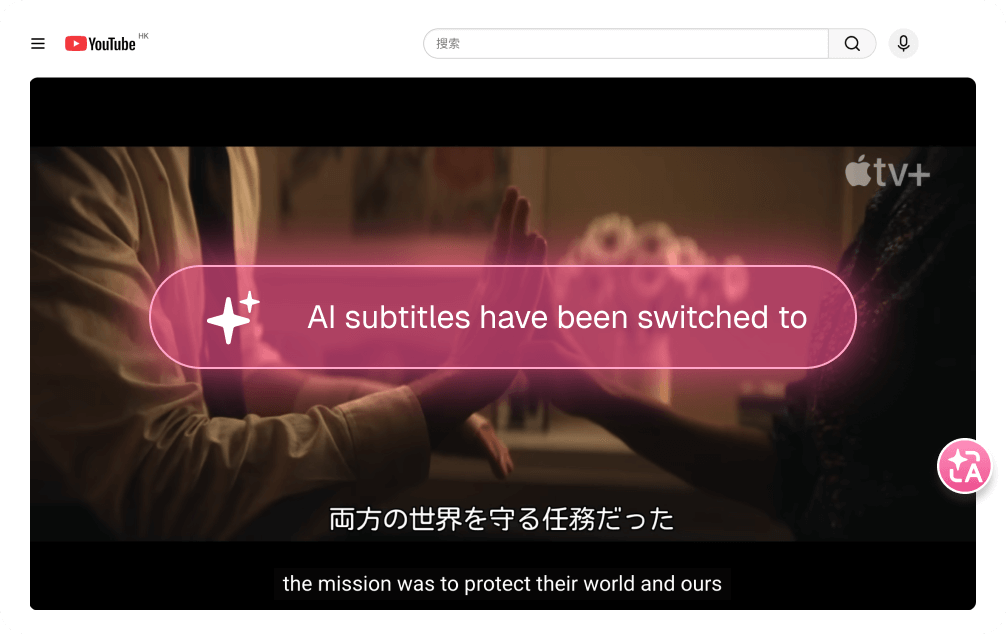
Real-Time Learning
Real-Time Learning

Watch DeepLearning.ai courses with instant bilingual subtitles appearing side-by-side, eliminating the need to pause or rewind for understanding complex AI concepts.

Context-Aware Translation

Our AI models understand technical terminology from machine learning and neural networks, delivering accurate translations that preserve the meaning of specialized DeepLearning.ai content.


Context-Aware Translation
Multi-Model Support
Multi-Model Support

Access ChatGPT, Claude, Gemini, and DeepSeek for translating Andrew Ng's lectures, ensuring you get the most accurate interpretation of advanced AI concepts.

Subtitle Editing

Customize and export translated subtitles from DeepLearning.ai courses for review, note-taking, or creating study materials that match your learning pace and style.

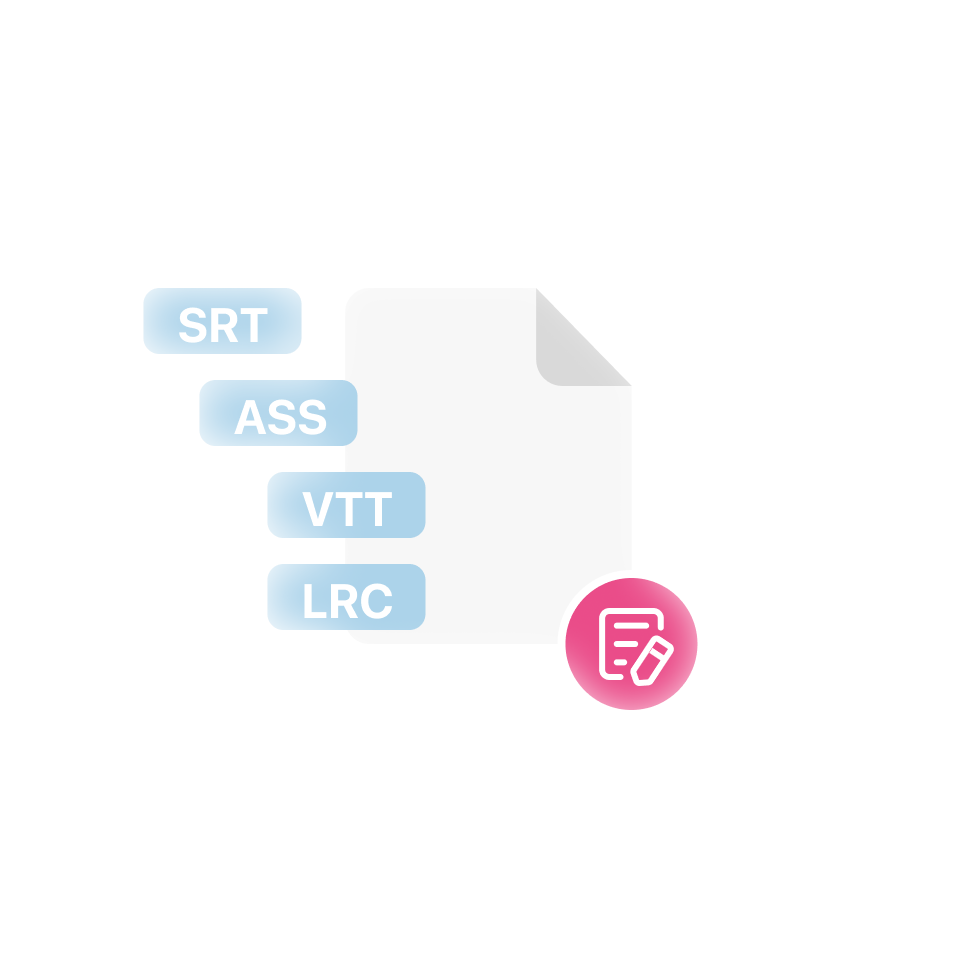
Subtitle Editing
Platform Integration

Works seamlessly on Coursera and YouTube where DeepLearning.ai hosts courses, providing consistent translation experience whether you're learning on desktop or mobile devices.

Learning Enhancement

See original English terms alongside translations, helping you build technical vocabulary while understanding DeepLearning.ai's neural network explanations and machine learning frameworks comprehensively.
Learning Enhancement

Supported categories

Streaming Services
Video Sharing
Online Education
Social Networking
News & Information
Creator Platforms
Developer & Technology Platforms

Frequently Asked Questions About Translating DeepLearning.AI Courses

Can I translate DeepLearning.AI course videos in real-time while watching?
Yes, with Immersive Translate's browser extension, you can watch DeepLearning.AI courses with real-time bilingual subtitles displayed side by side. Instead of pausing to look up terminology or waiting for separate translation processing, the extension automatically detects course videos on platforms like Coursera and generates translated subtitles as Andrew Ng speaks. This means you can follow along with complex AI concepts in your native language while simultaneously seeing the original English technical terms—essential for understanding machine learning vocabulary correctly. The bilingual subtitle format helps you build your technical English skills while ensuring you don't miss critical explanations about neural networks, gradient descent, or backpropagation algorithms.
How does Immersive Translate handle technical AI terminology in DeepLearning.AI courses?
Immersive Translate uses advanced AI models including ChatGPT, Claude, and Gemini to provide context-aware translation of technical content in DeepLearning.AI courses. Unlike basic machine translation that might mistranslate specialized terms like 'convolutional layers' or 'activation functions,' our AI-powered system understands the educational context and maintains technical accuracy. When Andrew Ng discusses concepts like 'overfitting' or 'regularization,' the translation preserves the precise meaning while making explanations accessible in your language. You can also customize which AI model to use—some users prefer Claude for more nuanced explanations of complex algorithms, while others choose ChatGPT for consistency across multiple course modules. This flexibility ensures you get the most accurate translation for deep learning terminology.
Can I translate DeepLearning.AI course materials beyond just videos?
Absolutely. While video translation is our standout feature for DeepLearning.AI courses, Immersive Translate offers comprehensive support for all course materials. You can translate PDF lecture notes, programming assignments, and supplementary readings with our bilingual parallel translation feature. When you're reviewing course PDFs about convolutional neural networks or recurrent architectures, simply activate the extension to see original English text alongside your language translation. This is particularly valuable for understanding mathematical notation and code comments in Jupyter notebooks. Additionally, our input box enhancement feature helps when you're participating in course forums or writing assignment submissions—you can compose questions in your native language and translate them to English, or understand English forum discussions from other learners worldwide.
Is it possible to save and review translated subtitles from DeepLearning.AI lectures for later study?
Yes, Immersive Translate allows you to edit and export subtitles in SRT format from DeepLearning.AI course videos. This feature is incredibly useful for creating personalized study materials. After watching a lecture on neural network architectures, you can export the bilingual subtitles to review key concepts offline, create flashcards from technical terms, or even share translated explanations with study groups. Many learners use this feature to build their own reference library of AI terminology—for example, exporting subtitles from the entire Machine Learning Specialization to create a searchable document of Andrew Ng's explanations. You can also edit translations if you prefer alternative phrasing for certain concepts, making your study materials perfectly aligned with how you understand deep learning principles.
Does Immersive Translate work across all DeepLearning.AI course platforms and specializations?
Immersive Translate supports DeepLearning.AI courses across multiple platforms including Coursera, where most specializations are hosted, as well as standalone course websites. Whether you're taking the Machine Learning Specialization, Deep Learning Specialization, Natural Language Processing courses, or the newer Generative AI programs, the translation functionality works consistently. Our browser extension recognizes video players on these educational platforms and automatically enables bilingual subtitle translation. This cross-platform compatibility means you can maintain the same learning experience whether you're watching introductory courses on supervised learning or advanced lectures on transformer architectures and large language models. The tool adapts to different video formats and subtitle structures used across DeepLearning.AI's expanding course catalog.
How can Immersive Translate help non-native English speakers complete DeepLearning.AI programming assignments?
Beyond translating video lectures, Immersive Translate significantly helps with DeepLearning.AI programming assignments through several features. When you're working in Jupyter notebooks, you can use the mouse hover translation to instantly understand code comments and instructions without leaving your workflow. The input box enhancement feature is particularly valuable when you need to search for error messages or look up documentation—translate your question into English to find better Stack Overflow results, or translate English documentation back to your language for deeper understanding. Many learners also use our webpage translation feature to understand course discussion forums where peers explain tricky concepts like vectorization or batch normalization. This comprehensive language support means language barriers won't prevent you from successfully implementing neural networks or debugging your gradient descent code.
What makes Immersive Translate better than downloading DeepLearning.AI transcripts and translating them separately?
The key difference is learning efficiency and context preservation. When you download transcripts and translate them separately, you lose the synchronized connection between what Andrew Ng is explaining visually on screen and the translated text. With Immersive Translate's real-time bilingual subtitles, you see diagrams of neural network layers exactly when the translated explanation appears, creating stronger conceptual connections. Our AI-powered translation also maintains context across the entire lecture—understanding that 'training' refers to model training, not physical exercise, based on surrounding discussion. Additionally, you avoid the workflow disruption of switching between video player, transcript file, and translation tool. Everything happens in one seamless experience, letting you focus on understanding backpropagation algorithms rather than managing multiple windows. For visual learners especially, this synchronized translation approach dramatically improves comprehension of complex AI concepts that DeepLearning.AI courses are known for teaching.