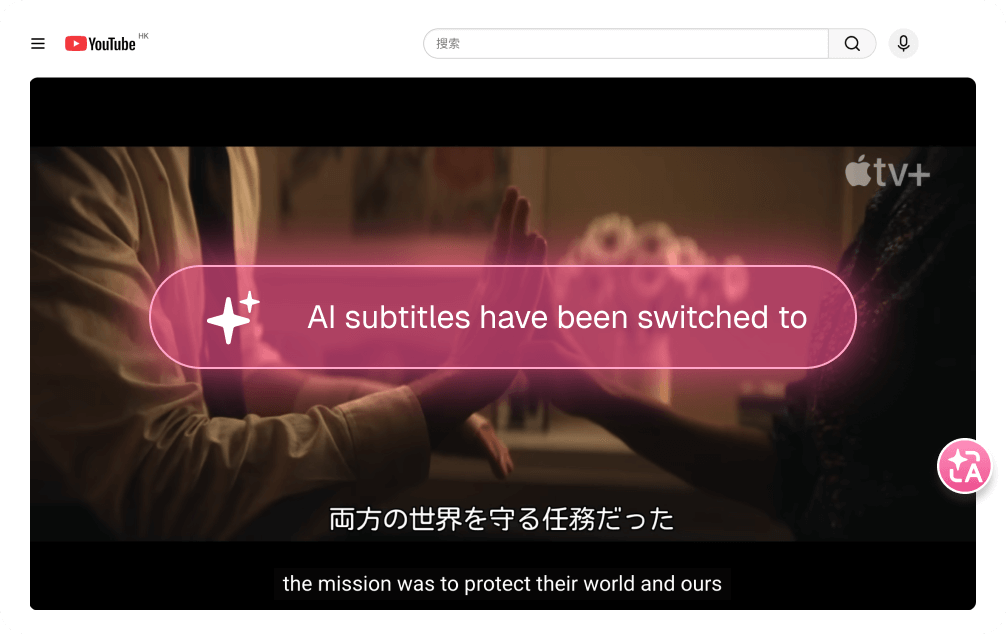
immersive translate logoImmersive Translate
English
google
openAI
Gemini
DeepL
Microsoft
Tencent Smart
Volctrans
Youdao
DeepSeek
Baidu
Niu
Caiyun
Tencent
OpenL
BigModel
SiliconFlow
google
openAI
Gemini
DeepL
Microsoft
Tencent Smart
Volctrans
Youdao
DeepSeek
Baidu
Niu
Caiyun
Tencent
OpenL
BigModel
SiliconFlow
google
openAI
Gemini
DeepL
Microsoft
Tencent Smart
Volctrans
Youdao
DeepSeek
Baidu
Niu
Caiyun
Tencent
OpenL
BigModel
SiliconFlow

Video translation demo

Chinese Movie with Japanese Subtitles Made Easy
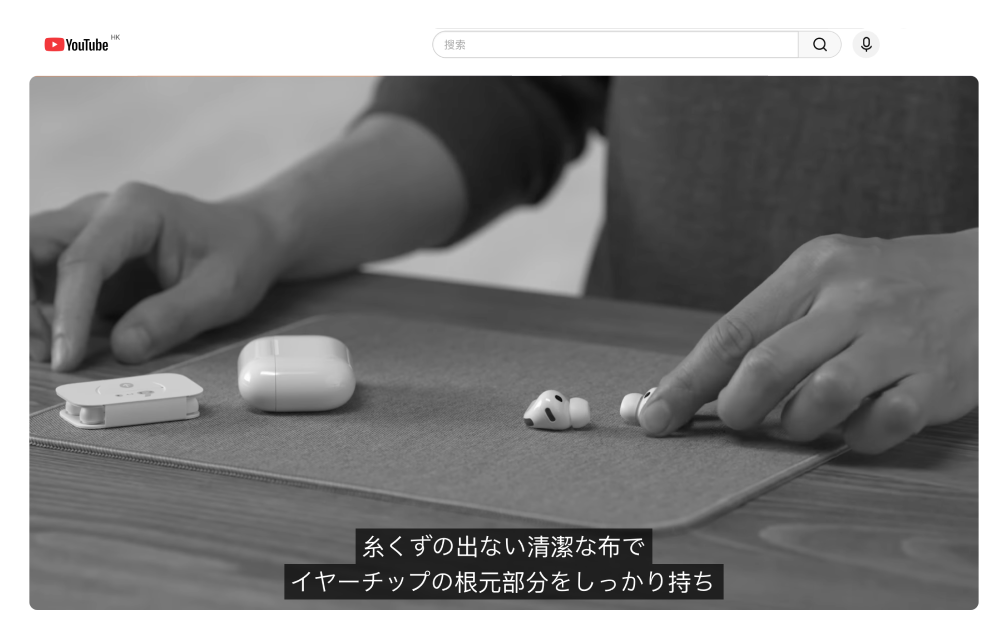
Immersive Translate Video Translator transforms how you watch Chinese movies with Japanese subtitles. Unlike traditional tools requiring download-translate-rewatch workflows, it displays bilingual subtitles in real-time during playback. Whether streaming on major platforms or pasting video links, you get instant side-by-side Chinese-Japanese subtitles, preserving original dialogue while understanding every scene effortlessly.
Before
user-pain-points
User Pains
Waiting for subtitle files to process before watching
Losing original Chinese context with Japanese-only translations
Limited platform support disrupts viewing experience across sites
After
happy-emoji
solutions
Immersive Translate Solution
happy-emojiReal-time bilingual subtitles without processing delays or downloads
happy-emojiSide-by-side Chinese-Japanese display preserves original linguistic context completely
happy-emojiWorks across 60+ platforms via browser extension or link
happy-emojiAI-powered translation ensures natural, context-aware Japanese subtitle quality

Four steps to enjoy content in your native language

1

Copy & paste video link

2

Click Translate Video and wait a moment

3

Click Play Immediately to view

Watch Chinese Movies with Japanese Subtitles Instantly

Real-Time Translation

Watch Chinese films with instant Japanese subtitle translation powered by 20+ AI engines including DeepL and ChatGPT, displaying both original Chinese and Japanese text side-by-side for immediate comprehension without processing delays.

Bilingual Learning

Study Mandarin while enjoying Chinese movies through parallel Chinese-Japanese subtitles, helping Japanese speakers understand dialogue context, learn new vocabulary, and grasp cultural expressions that pure translation alone cannot convey effectively.


Bilingual Learning
Platform Flexibility

Access Chinese cinema with Japanese subtitles across YouTube, Netflix, and 60+ video platforms through browser extension or web link translation, ensuring consistent bilingual subtitle experience regardless of where you discover Chinese films online.

Cultural Preservation

Maintain authentic Chinese cultural context while reading Japanese translations, as bilingual display prevents loss of original idioms, wordplay, and regional expressions that often disappear in single-language subtitle versions of Chinese movies.

Cultural Preservation
Subtitle Customization

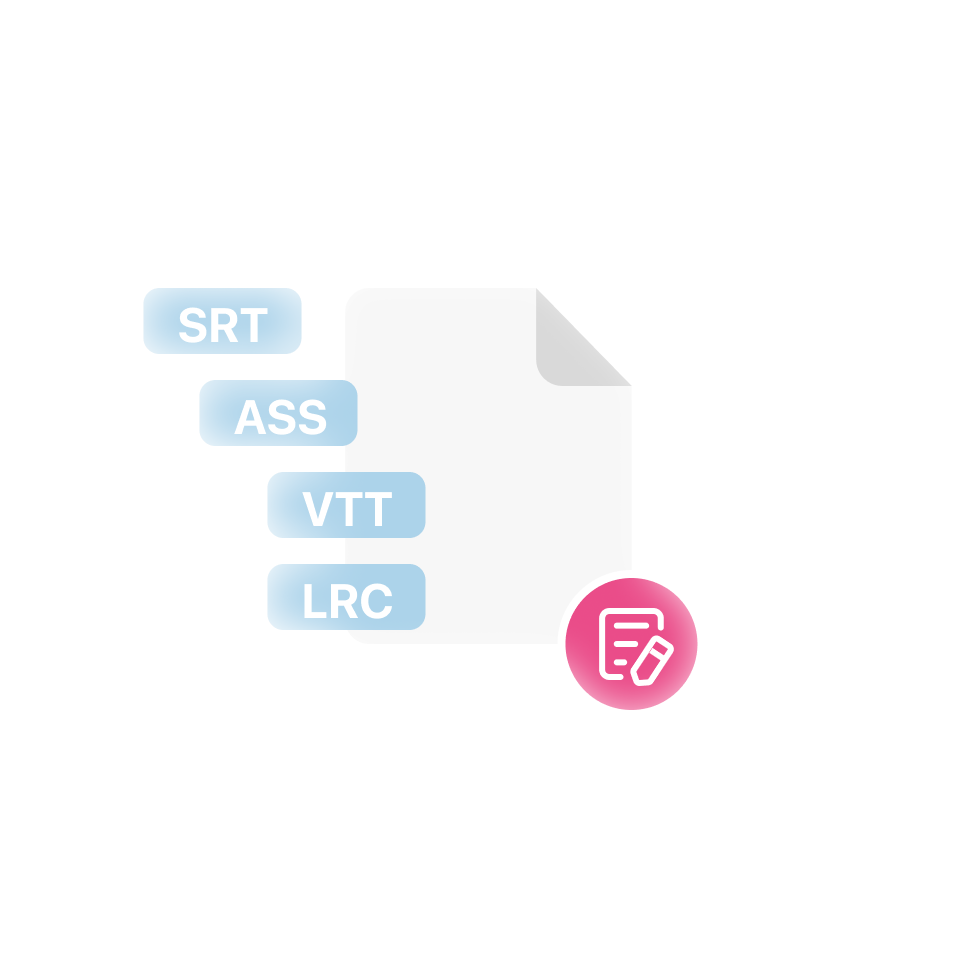
Adjust Japanese subtitle font size, color, background opacity, and screen position for optimal readability during Chinese film viewing, with exportable SRT files for offline study or content creation purposes after translation completion.

No Waiting

Enjoy newly released Chinese movies immediately with AI-generated Japanese subtitles instead of waiting months for official localization, as Immersive Translate processes subtitles during playback without requiring pre-download or separate transcription workflows.

No Waiting

Supported categories

Streaming Services
Video Sharing
Online Education
Social Networking
News & Information
Creator Platforms
Developer & Technology Platforms

Frequently Asked Questions About Watching Chinese Movies with Japanese Subtitles

How can I watch Chinese movies with Japanese subtitles when they're not officially available?
Many Chinese films don't come with official Japanese subtitles, especially newer releases or niche titles. Immersive Translate solves this by generating bilingual subtitles in real-time. Simply paste the video link into our web translator or use our browser extension while watching on platforms like YouTube or streaming sites. The tool automatically detects Chinese dialogue and creates Japanese subtitles alongside the original Chinese text. This side-by-side display is particularly valuable for Japanese learners studying Chinese, as you can compare both languages simultaneously. For videos without any subtitles, our AI subtitle generation feature (available with Pro membership) can transcribe the Chinese audio first, then translate it into Japanese. You can also customize subtitle appearance—font size, color, position—to match your viewing preferences, ensuring comfortable reading whether you're watching on a phone, tablet, or large screen.
Which platforms support Chinese to Japanese subtitle translation for movies?
Immersive Translate works across 60+ major video platforms, making it incredibly versatile for watching Chinese cinema with Japanese subtitles. This includes YouTube (where many Chinese films are uploaded), Netflix (for Chinese dramas and movies in their catalog), and various Chinese streaming platforms accessible internationally. The browser extension integrates directly into these sites, so you never need to leave the page you're watching. For social media platforms like X (Twitter) where Chinese film clips are shared, you can paste the post link into our web translator. The platform-agnostic design means if a video has detectable audio or existing subtitles, translation is usually possible. This is especially useful for Chinese film festivals, director interviews, behind-the-scenes content, and classic movies that lack official Japanese localization. Unlike downloading subtitle files separately and syncing them manually, Immersive Translate handles everything automatically during playback.
Can I use Immersive Translate to study Chinese through Japanese-subtitled movies?
Absolutely—this is one of the most powerful use cases. The bilingual subtitle feature displays both Chinese (original) and Japanese (translation) simultaneously, creating an immersive learning environment. As you watch Chinese movies, you can see how specific Chinese phrases are expressed in Japanese, building vocabulary and understanding cultural nuances in both languages. The context-aware translation powered by AI engines like ChatGPT, DeepL, and Gemini ensures natural, fluent Japanese that reflects the actual meaning rather than word-for-word translation. You can pause at any moment to study particular expressions, and our subtitle editing feature lets you annotate or correct translations for personal study notes. After watching, export the bilingual subtitle file in SRT or ASS format to review later or import into flashcard apps. This method is far more engaging than traditional textbook learning—you're absorbing language through compelling stories, authentic dialogue, and emotional performances. Many Japanese learners of Chinese use this approach with wuxia films, historical dramas, and contemporary Chinese cinema to accelerate their comprehension skills.
How accurate is AI translation for Chinese movie dialogue into Japanese?
Translation accuracy depends on several factors, but Immersive Translate maximizes quality through multiple strategies. We integrate 20+ top-tier AI translation engines including ChatGPT, DeepL, DeepSeek, and Google Translate, supporting 100+ language pairs. For Chinese-to-Japanese translation specifically, these models have been trained on vast amounts of bilingual data and understand cultural context, idiomatic expressions, and tone. The context-aware translation analyzes surrounding dialogue rather than translating sentences in isolation, which is crucial for Chinese films where meaning often depends on previous scenes or cultural references. However, quality does depend on the source material—if you're watching a video with high-quality original Chinese subtitles or clear audio, translation will be more accurate. For films with heavy regional dialects, classical Chinese, or specialized terminology (like martial arts terms in kung fu movies), you may occasionally need to reference the original text, which is why our bilingual display is so valuable. You can also switch between different translation engines mid-viewing to compare outputs and choose the most natural-sounding Japanese version. The subtitle editing feature allows you to refine any awkward translations for future reference.
Can I download Chinese movies with embedded Japanese subtitles using Immersive Translate?
While Immersive Translate doesn't download videos themselves (due to copyright considerations), it offers powerful subtitle export capabilities that serve a similar purpose. After translating a Chinese movie into Japanese, you can export the bilingual subtitle file in SRT or ASS format. These industry-standard formats can be embedded into video files using free tools like VLC Media Player, Aegisub, or HandBrake. This is particularly useful for content creators who want to add Japanese subtitles to Chinese film clips for YouTube videos, educational content, or cultural commentary. The exported subtitles maintain timing synchronization and can include your custom edits if you've refined any translations. For personal study, you can keep these subtitle files as reference materials, reviewing key dialogue or memorable quotes from your favorite Chinese films. This workflow is especially valuable for film students, translators-in-training, or anyone building a personal library of bilingual Chinese cinema resources. The subtitle file translation feature also works in reverse—if you already have a Chinese subtitle file (.srt or .ass), you can upload it directly to Immersive Translate for batch translation into Japanese without needing the video.
What's the difference between using Immersive Translate versus downloading separate Japanese subtitle files for Chinese movies?
Traditional subtitle downloading requires finding the exact subtitle file (often from unreliable sources), ensuring it matches your video version, manually syncing timing if it's off, and loading it into a player—a time-consuming process that often results in mismatched dialogue. Immersive Translate eliminates all these steps by generating Japanese subtitles in real-time as you watch. There's no searching subtitle databases, no downloading files from questionable websites, and no technical troubleshooting. More importantly, downloaded subtitle files are typically Japanese-only, meaning you lose access to the original Chinese text. Our bilingual display keeps both languages visible, which is invaluable for language learners, translators, and anyone who wants to verify translation accuracy. The real-time approach also means you can watch newly released Chinese films immediately—you don't need to wait weeks or months for fan translators to create Japanese subtitle files. For videos without any existing subtitles, our AI subtitle generation creates them from scratch, something impossible with traditional subtitle databases. Additionally, you can customize subtitle appearance on the fly (font, size, color, position) rather than being locked into whatever formatting the downloaded file uses.
Can Immersive Translate handle different Chinese dialects and regional films when creating Japanese subtitles?
Immersive Translate's effectiveness with regional Chinese cinema depends on the source material's subtitle quality and audio clarity. For Mandarin-language films (the vast majority of Chinese cinema), translation accuracy is excellent across all AI engines. When watching Cantonese films, Taiwanese movies with Hokkien dialogue, or regional productions featuring dialects, the tool works best if the video already has Chinese subtitles (either Mandarin or the dialect itself). The translation engines can then convert those Chinese subtitles into Japanese accurately. For dialect-heavy films without subtitles, our AI subtitle generation feature may have reduced accuracy since it's primarily trained on Mandarin. However, many classic Hong Kong films, Taiwanese cinema, and regional Chinese movies available on streaming platforms do include Chinese subtitles, making them fully compatible. An additional benefit for Japanese viewers interested in Chinese linguistic diversity: the bilingual subtitle display lets you see how Mandarin subtitles represent Cantonese or other dialect speech, providing insight into Chinese language variation. For specialized content like historical Chinese films with classical language or martial arts movies with archaic terminology, you can switch between translation engines (DeepL often excels at nuanced cultural translation, while ChatGPT handles context well) to find the most natural Japanese rendering.