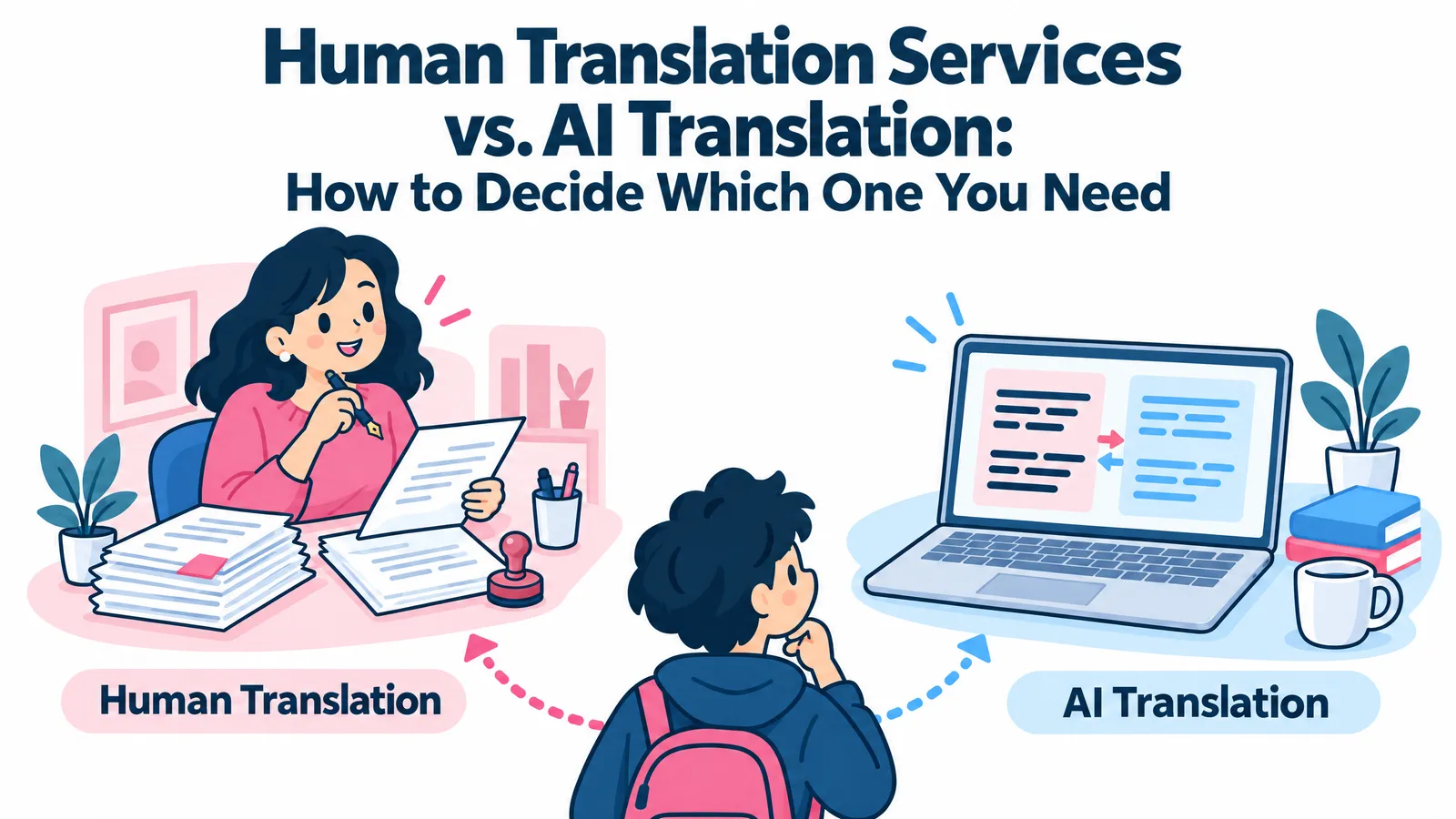
Human Translation Services vs. AI Translation: How to Decide Which One You Need
You have something to translate—a contract, a birth certificate, a stack of research papers, a website you need to read—and you're weighing a human translation service against an AI translation tool. The honest answer is that neither option wins across the board. The right choice depends on three things: what the translation is for, whether the receiving institution has certification requirements, and how your budget and deadline stack up. This guide compares both paths on those terms and gives you a task-based framework you can apply to any translation decision in a few minutes.
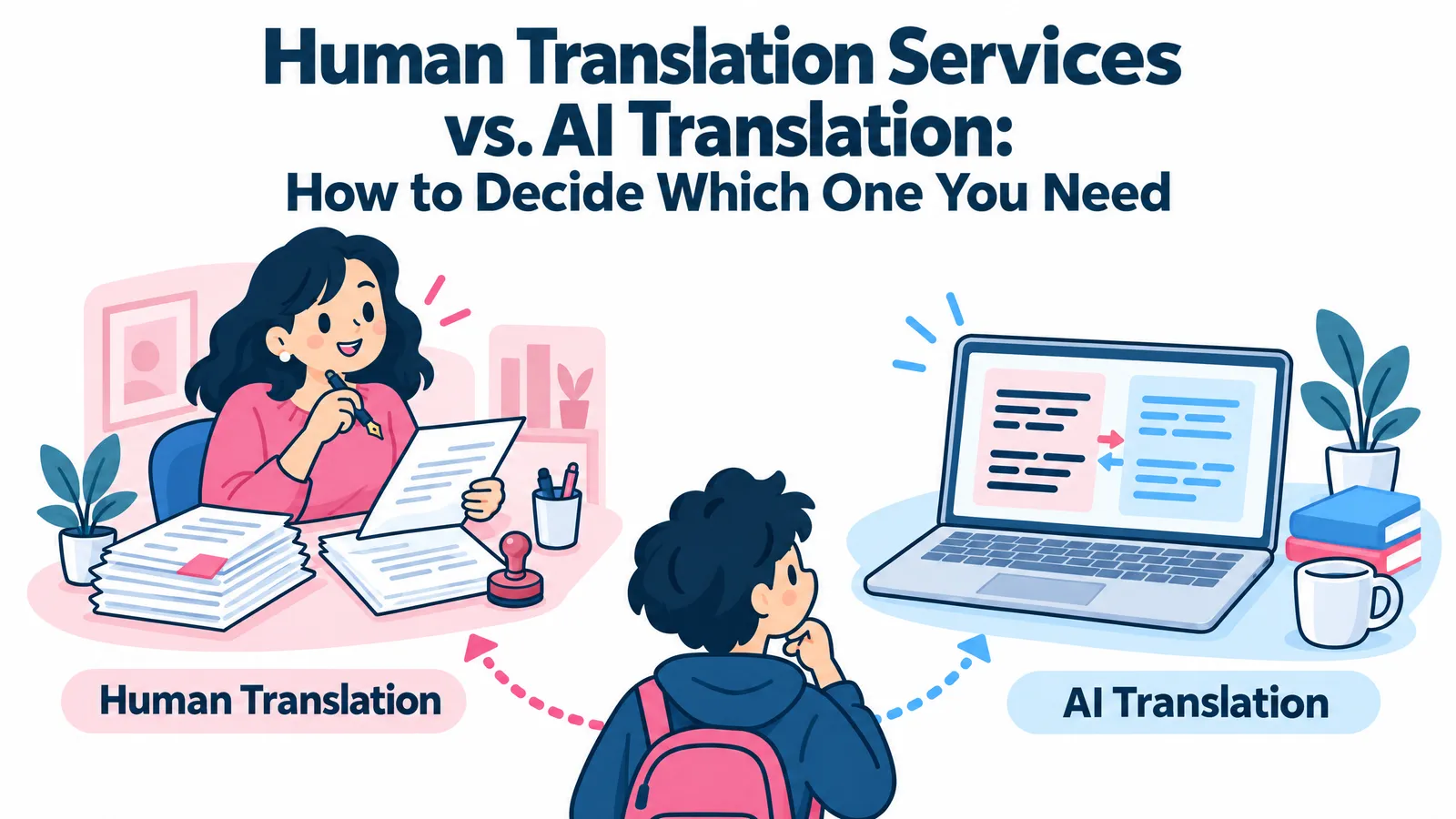
Human Translation vs. AI Translation: The Short Answer
If the translation will be submitted to an official body—an immigration office, a court, a university—use a human certified translation service. If you need to understand foreign-language content—web pages, PDF reports, video, everyday documents—an AI translation tool does the job in seconds at a fraction of the cost. And if you need both (understand first, submit later), use a hybrid workflow: AI to read, human translators for the pages that actually get filed.
There is no single "best" answer for everyone; the right choice follows the task. This table maps the most common situations to the better fit:
| Your task | Better fit | Why |
|---|---|---|
| Birth certificate, marriage license, or diploma for official submission | Human certified translation service | Receiving institutions typically require a certified translation with a signed accuracy statement |
| Contract or legal filing for court | Human certified translation service | Certified format, legal accountability, optional notarization |
| Reading a foreign-language website or news site | AI translation tool | Instant bilingual translation in the browser, free to start |
| Reviewing a PDF report, paper, or manual before deciding what to submit | AI tool first, human service for what you file | Layout-preserving PDF translation is instant; pay per page only for certified work |
| Understanding a video lecture, webinar, or streaming show | AI translation tool | Real-time bilingual subtitles are an AI-native capability |
| Reading manga, webtoons, or comics as chapters release | AI translation tool | Instant, layout-aware translation of text in images |
The rest of this guide explains what each option does best, what it costs, and how to decide.
What Human Translation Services Do Best
Search for translate services and the top results are dominated by certified human agencies—for good reason. Human translation services solve a problem AI tools cannot: producing translations that institutions will accept.
When you file an immigration petition, submit academic records, or file with a court, the receiving institution usually wants a certified translation—a translation accompanied by a signed statement from the translator or agency attesting to its accuracy and completeness. Many U.S. providers advertise that their certified translations are accepted by USCIS, and several also offer notarization and apostille services for international use.
That guarantee comes with a per-page cost structure. Among the top-ranking U.S. translation services surveyed on October 15, 2026, certified document translation was advertised at $20–$39 per page:
| Service | Advertised pricing (Oct 15, 2026) | Advertised turnaround |
|---|---|---|
| RushTranslate | Certified from $24.95/page | Starting at 24 hours |
| Translation Services USA | Certified $24.95/page; business $0.10/word | Most documents in 24 hours |
| Universal Translation Services | Certified from $20/page | Rush options available |
| U.S. Language Services | Certified $39.00/page; standard $0.12/word | Expedited options available |
Prices are as advertised on each provider's homepage at the time of the survey and may change; confirm current pricing before ordering.
Beyond certification, professional translation services offer:
-
Fast, defined turnaround. 24-hour delivery is a standard offering at several major services, with expedited options for urgent deadlines.
-
Human review and accountability. A professional translator—often with a second linguist reviewing the work—is responsible for the output, and the service stands behind it.
-
Services AI tools don't provide. Notarization, apostille, sworn translation, and in-person interpreting all remain human-service territory.
If an official body will review your document, these capabilities aren't optional extras—they're the product. A per-page fee buys a certified document backed by an accountable service.
What AI Translation Tools Do Best
AI translation tools are built for the other category of translation work: understanding content. Their strengths:
Instant output. An AI tool translates in seconds, not 24 hours. For fast translations of anything you need to read right now—a contract before a call tonight, a paper before class, an email that just arrived—instant delivery changes what's possible.
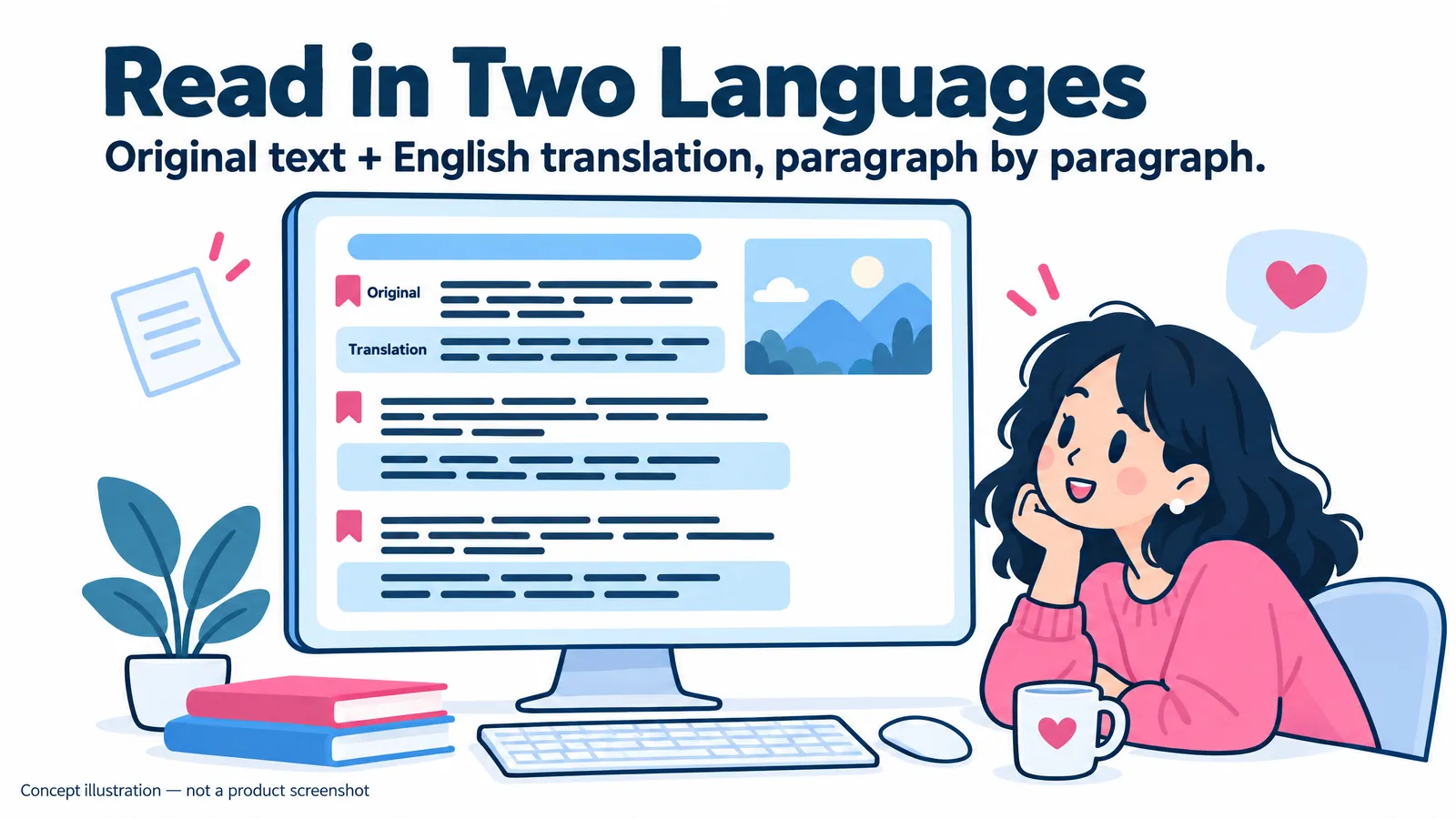
Digital-content coverage. Modern AI translators work where you actually read. Immersive Translate, for example, translates full web pages into a side-by-side bilingual layout and translates PDFs while preserving the original formatting (including scanned PDFs via OCR). It delivers real-time bilingual subtitles on more than 100 video platforms including YouTube and Netflix, translates live meetings on Zoom, Google Meet, and Microsoft Teams, and handles images and comics. For quick lookups, you can select a word or phrase for an instant translation, hover over a paragraph, or type in any input box.
Choice of engines. AI tools let you choose among leading translation engines rather than being locked into one. The tool integrates more than 20 engines—including ChatGPT, DeepL, DeepSeek, and Gemini—across more than 100 language pairs, with context-aware translation and customizable terminology libraries for domain-specific accuracy.
A different cost model. AI tools start free and use subscriptions rather than per-page pricing for heavier use. If you translate occasionally, understanding a foreign-language document can cost nothing; if you translate daily, a flat subscription replaces per-page fees that would multiply quickly. You can compare the free and Pro plans on the pricing page.
Scale matters for trust, too: Immersive Translate is used by more than 30 million users and was recognized as a Chrome Web Store 2024 Favorite. One technology blogger who tracks overseas AI research writes that the tool "has almost become my default reading environment" for documentation and papers from teams like OpenAI and Anthropic, because the original text stays in place while the translation appears beneath it.
For sensitive documents, check how a tool handles your content—the extension publishes its privacy and security commitments, including encrypted requests and a policy of not using your content to train models.
The boundary. AI translation tools—including Immersive Translate—do not provide certified translation, notarization, apostille, or any acceptance guarantee. If your document will be submitted to an official body, use a human certified translation service. For everything you read, watch, and write, the online text translation tool covers the task instantly. It works on Chrome, Edge, iOS, and Android—try Immersive Translate for free.
How to Decide: A Task-Based Framework
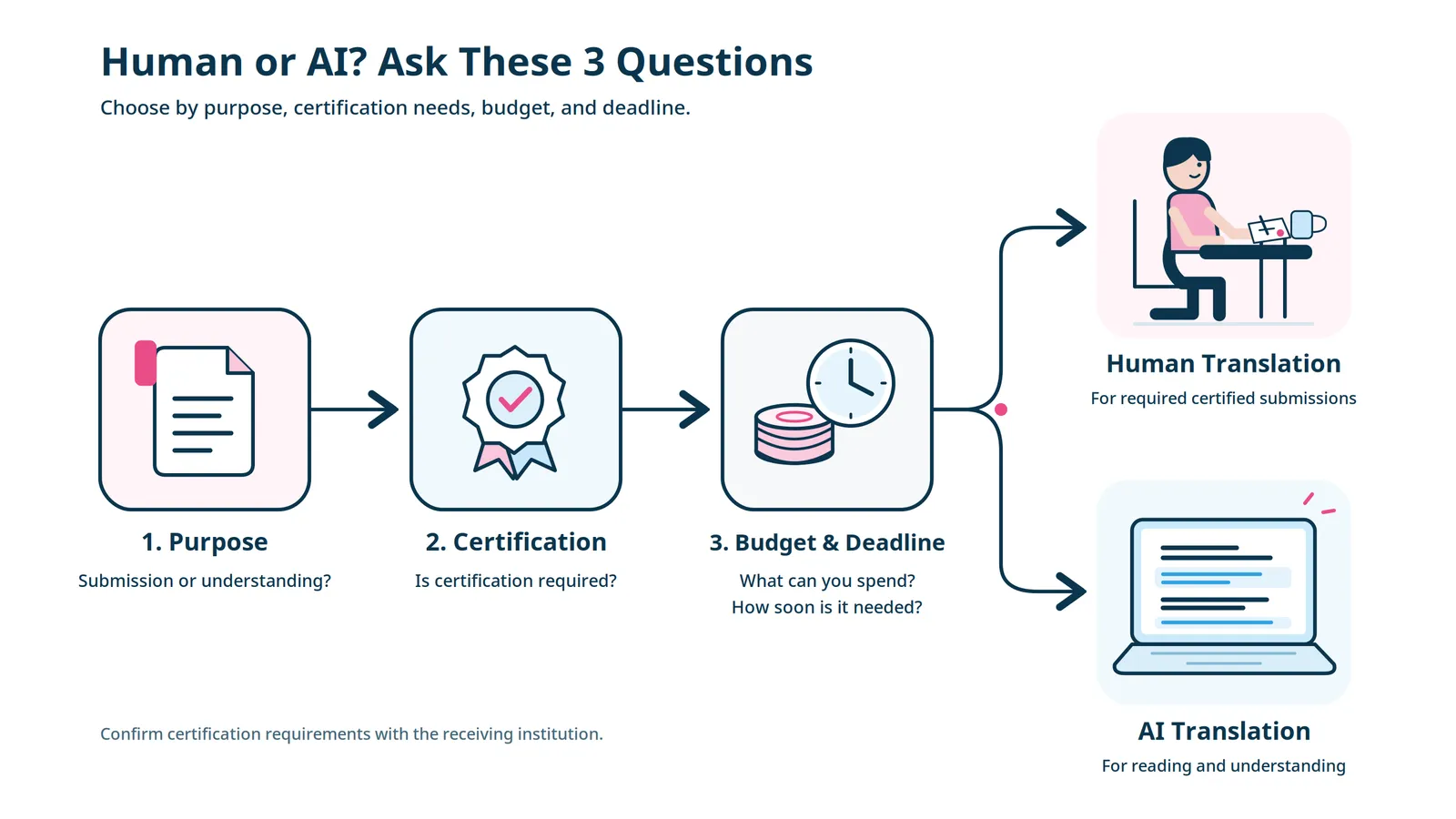
Work through three questions in order:
-
What is the translation for? Official submission (immigration, court, academic credential evaluation) or understanding (reading, reviewing, learning)? Submission points toward a human service; understanding points toward an AI tool.
-
Does the receiving institution require certification? If the document needs certified, notarized, or apostilled translation, a human service is the only path that provides it. If no institution will ever see the document, certification is irrelevant.
-
What do budget and deadline allow? Human certified work runs roughly $20–$39 per page with 24-hour turnaround; AI tools translate instantly, free to start, with subscriptions for heavy use.
| Task | Decision | Reason |
|---|---|---|
| Immigration petition (birth certificate, marriage license) | Human certified service | Certification is typically required here—budget roughly $20–$39 per page |
| Court filing or legal submission | Human certified service (ask about notarization) | The filing needs certified format and a service accountable for accuracy |
| Academic credential evaluation | Human certified service | Evaluators typically expect certified transcripts and diplomas |
| Reviewing a contract or business document before a meeting | AI tool first | Read it in minutes at no cost; pay per page only if it ends up filed |
| Daily reading of foreign news, research, or documentation | AI tool | High volume multiplies per-page fees; a free tier or subscription fits ongoing reading |
| Watching lectures, webinars, or streaming video | AI tool | Live subtitles as the video plays—no waiting on a 24-hour turnaround |
| Reading manga or webtoons as chapters release | AI tool | Chapters become readable the moment they release |
Choose human translation when:
-
The document will be submitted to an official body that requires certified translation
-
You need notarization, apostille, or sworn translation
-
Errors carry legal or financial consequences, and you want a service accountable for accuracy
-
The text is short, high-stakes, and needed within 24 hours
Choose AI translation when:
-
You need to understand the content, not file it
-
You're translating web pages, PDFs, video, or images in real time
-
Volume is high or ongoing, and a subscription suits you better than per-page fees
-
You want bilingual reading—original and translation side by side—rather than a replacement document
A Hybrid Workflow: When to Use Both
Many real projects need both paths. A two-step workflow handles them:
Step 1: Read everything with AI first. Before spending anything, run your documents through an AI translator. PDF translation preserves the original layout and handles scanned files via OCR, so you can read the full content of a foreign-language file—contracts, records, correspondence—in minutes and know exactly what you're dealing with.
Step 2: Buy certified translation only for what you submit. Once you know which documents the institution actually requires, order human certified translation for just those pages. If a ten-page packet contains one certificate that must be filed, you pay per-page rates for the certificate, not the whole packet.
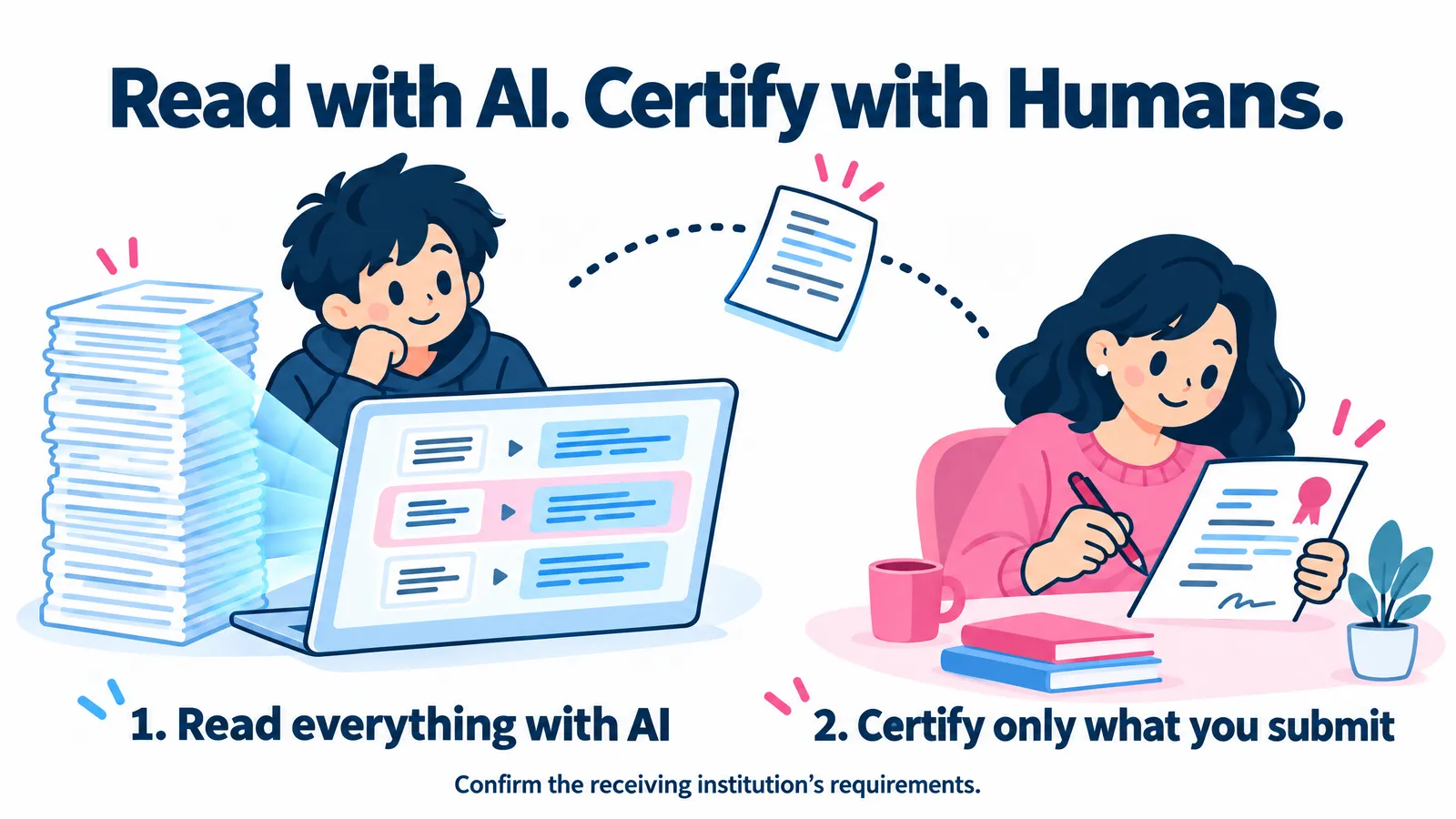
The logic is simple: per-page human pricing makes sense for pages an official body will review, but it's an expensive way to merely read content. Use an online translation service for understanding, and reserve professional translation spending for the documents that carry legal weight.
FAQ
How much does it cost to translate something?
For human certified document translation, top U.S. services advertised $20–$39 per page when surveyed on October 15, 2026, with business translation around $0.10–$0.12 per word. Prices change, so confirm before ordering. AI translation tools are free to start, with paid subscriptions for heavier use rather than per-page fees.
What is the best translation service?
There's no single best—it depends on the task. For documents submitted to official bodies, a human certified translation service is the right fit, because institutions require certification. For reading web pages, PDFs, and video, an AI translation tool is faster and comes at no upfront cost. Match the service type to your task, not to a ranking.
Can you hire a personal translator?
Yes. Individual translators and small studios handle personal documents—one Utah-based translator surveyed for this guide, for example, specializes in birth, marriage, and divorce certificates with one- to two-business-day turnaround. An online translation service complements this: it's the faster option for everything you need to understand rather than file.
Do you use machine translation?
Some human services state they never use machine translation, positioning human-only work as their quality standard; AI translation tools are built on it and add value through engine choice, context handling, and bilingual presentation. The quality logic differs: human services sell review and accountability, while AI tools sell speed and coverage. Neither replaces the other for the tasks it wasn't designed for.
What is a certified translation?
A certified translation is a translation accompanied by a signed statement from the translator or agency attesting that it is accurate and complete. It's commonly requested for immigration petitions, court filings, and academic submissions. Requirements vary by institution—confirm with the receiving organization before ordering. AI translation tools, including Immersive Translate, do not issue certified translations.
For more questions about how Immersive Translate works, see the official FAQ.
If you take one thing from this guide, make it this: decide by purpose, not by habit. Official submission means a human certified translation service. Understanding and daily reading mean an AI translation tool that works in your browser, your documents, and your video. For mixed projects, read with AI and certify only what gets filed.
If most of your work is understanding foreign-language content, start with the tool: try Immersive Translate for free, or see the free and Pro plans if you translate daily. For more guides like this one, browse the Immersive Translate blog.